>Support>Technical library>What Factors Affect Current Clamp Measurement Accuracy?
What Factors Affect Current Clamp Measurement Accuracy?10-09, 2026
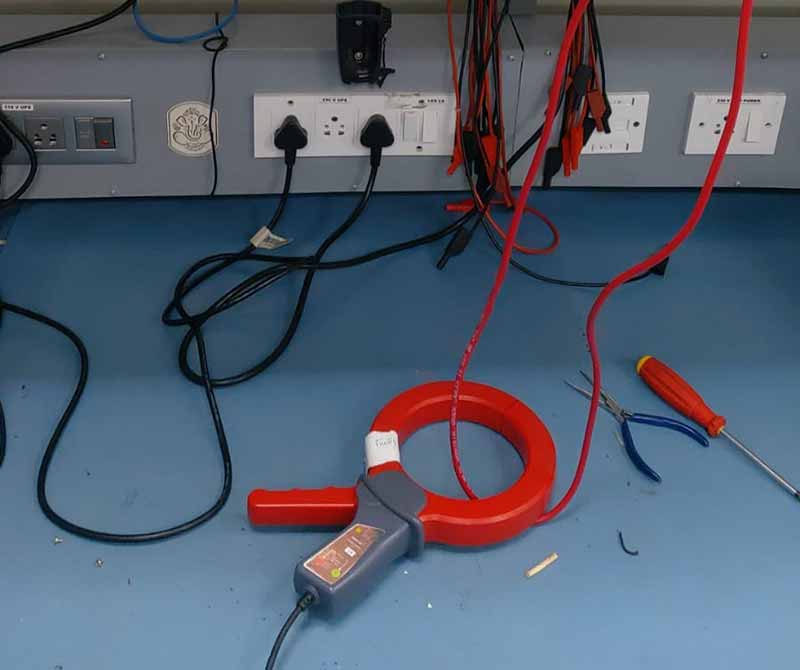
A current clamp may be easy to install, but achieving accurate measurements requires more than simply placing the jaws around a conductor.
Several electrical and mechanical factors can influence measurement accuracy.
Conductor Position
The position of the conductor inside the clamp can affect the magnetic field distribution detected by the sensor.
For precision applications, the conductor should normally be positioned consistently according to the manufacturer's recommended measurement procedure.
Jaw Closure
For split-core current clamps, the magnetic circuit must close properly.
Dust, foreign objects, mechanical damage, or incomplete jaw closure can affect the magnetic circuit and therefore measurement accuracy.
Current Range
Operating too close to the extreme limits of the sensor range can affect accuracy.
For precision measurements, select a current probe whose rated range is appropriate for the actual measurement.
Frequency
Current clamp accuracy is frequency-dependent.
A probe designed primarily for 50/60 Hz measurement may not provide the same performance when measuring high-frequency switching currents.
Therefore, frequency response should always be considered when testing power electronics or transient signals.
Temperature
Temperature can influence sensor characteristics, particularly in Hall Effect measurement systems.
Long-term stability and temperature drift should therefore be considered in precision DC or AC/DC applications. HIOKI also notes that Hall-element sensors can experience drift related to temperature and time.
External Magnetic Fields
Strong nearby conductors or magnetic equipment may introduce additional magnetic fields.
When possible, avoid positioning the current probe close to unrelated high-current conductors.
Current Direction
For AC/DC probes, the direction of the conductor through the sensor can affect the polarity of the output signal.
This is especially important when measuring current waveform phase or power direction.
For reliable current clamp measurements, engineers should pay attention to:
1. Conductor position
2. Jaw closure
3. Current range
4. Frequency
5. Temperature
6. External magnetic fields
7. Probe orientation
8. Instrument compatibility
Proper installation is just as important as selecting a high-quality sensor.